
ELUA is the platform where funders,doers, and thinkers arrive at shared clarity, so capital moves with confidence toward what can actually shift.

The world doesn't lack effort. It lacks clarity.

The world doesn't lack effort. It lacks clarity.

Somewhere, right now, a funder is reading a pitch deck on how to solve a complex societal challenge. They want to believe it will work, yet they hesitate. Not because of a lack of effort, talent, or creativity. Because they can't see what's actually driving the problem clearly enough to know whether the solution reaches it.

ELUA is the platform where funders, doers, and thinkers gather around a complex societal problem and build a shared strategic map grounded in what's driving the problem so capital can flow with confidence toward the highest-leverage work.
At age 16 Boyan Slat went diving off the coast of Greece, and saw more plastic than fish.

He went home and designed a machine that would use ocean currents to collect it.

Before long he was giving a TEDx talk. It went viral. Within months he was actually building the system he had pitched — a global team, tens of millions in funding, the full weight of public hope behind him. The systems worked. However, for every kilogram removed, more plastic arrived.

Then came the discovery that reframed everything: eighty percent of ocean plastic arrives through just 1% of the world's rivers. The cause was upstream — literally — and it took a decade to find it. Boyan got there. His persistence ensured he would. Today The Ocean Cleanup removes more plastic in a single year than in all previous years combined. But the insight that unlocked the strategy was available earlier.

What was missing wasn't intelligence or effort.
What was missing was a methodology designed for problems this complex.

ELUA is that methodology, and it stands on shoulders worth acknowledging.

Buckminster Fuller

These are some of the rare thinkers who saw what most people missed: that complex problems are solved at the source, not at the surface. That solving one part of a problem can make another part worse. That the organisations built around a problem have little structural interest in its resolution.

This is the gift of systems awareness: seeing past surface symptoms to discovering what is generating and sustaining them. 

Their work lived in universities and expensive consulting engagements. It reached organisations wealthy enough to find and retain the right advisors. It rarely reached founders at the moment of first commitment when the strategy that would govern the next decade was still being formed.

Most people working on hard problems never get the time to define them properly. They get a pitch deadline.

"If I had one hour to save the world, I would spend the first fifty-five minutes defining the problem."
Attributed to Albert Einstein
What changes when quality thinking arrives at the beginning.

Before the first dollar is committed. Before the direction becomes a plan. Before assumptions calcify into decisions.

A funder stops asking whether to trust the argument and starts examining what's actually driving the problem — what has already been tried, where the system is most likely to resist. A founder stops defending a position and starts stress-testing it against reality before the cost of being wrong becomes the cost of a decade.

This is what ELUA produces. Not a better pitch, a shared strategic map.

The Tree holds the strategy. The Thesis communicates it.

The Tree holds the strategy. The Thesis communicates it.

Mission Strategy Tree

Mission Strategy Thesis

The Mission Strategy Tree

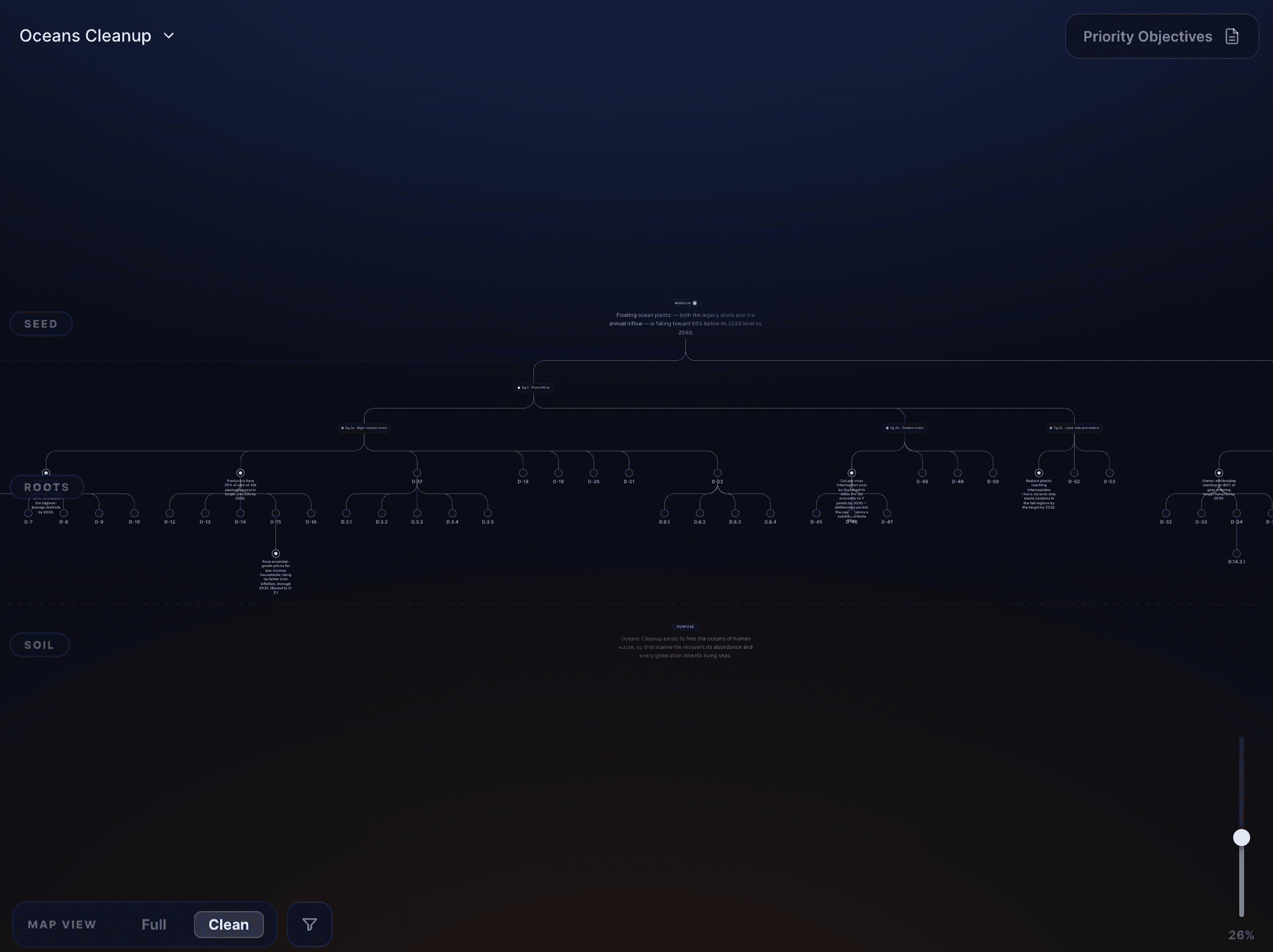
This is where the thinking lives — the causal logic of the problem, the analysis that helped surface deeper insights, the criteria for solutions to be effective, and proposed solutions scored for viability. Built through a guided process. Visible to everyone who needs to act on it.

The Tree is the structure underneath the strategy, built alongside the analysis as the thinking deepens. Designed to be explored by you, your team, and anyone you bring to it.

Mission Strategy Tree

Mission Strategy Thesis

The Mission Strategy Tree

This is where the thinking lives — the causal logic of the problem, the analysis that helped surface deeper insights, the criteria for solutions to be effective, and proposed solutions scored for viability. Built through a guided process. Visible to everyone who needs to act on it.

The Tree is the structure underneath the strategy, built alongside the analysis as the thinking deepens. Designed to be explored by you, your team, and anyone you bring to it.

Strategy Tree

Strategy Thesis

The Mission
Strategy Tree

This is where the thinking lives — the causal logic of the problem, the analysis that helped surface deeper insights, the criteria for solutions to be effective, and proposed solutions scored for viability. Built through a guided process. Visible to everyone who needs to act on it.

The Tree is the structure underneath the strategy, built alongside the analysis as the thinking deepens. Designed to be explored by you, your team, and anyone you bring to it.

Five steps from Intention to Thesis

Five steps from Intention to Thesis

Intention

Hypothesis

Analysis

Solutions

Strategy

Define the mission precisely enough to build strategy on it.

You'll articulate what you're working toward and why — in terms specific enough to make decisions with. By the end of this stage, you'll have a mission statement that does more than describe your work. It will distinguish what belongs in your strategy from what doesn't, and give everyone working alongside you a shared point of reference.

Build a working theory of what needs to change and why.

You'll map your current thinking about the problem — what's driving it, what's kept it stuck, and where change might actually be possible. You don't need to have it figured out. You need to have it written down in a form that analysis can work with.

Surface the drivers, dynamics, and root causes beneath the problem.

You'll move through the structural forces, stakeholder relationships, and underlying problems and what has kept them in place. What comes out the other side isn't more complexity — it's a clear picture of where the system can actually be shifted, and at what level your strategy needs to operate.

Identify solutions rooted in your analysis.

You'll assess potential solutions against the criteria your analysis surfaced: what the system requires, where the leverage is, and what the benefit-to-cost case looks like. You won't leave with a list of options. You'll leave with a strategic direction grounded in the specific problem you've diagnosed.

Turn your strategic logic into something visible, shareable, and fundable.

You'll bring everything together into two outputs. The Mission Strategy Tree makes your full strategic logic visible in one place — so funders, partners, and team members can see the same problem the same way. The Mission Strategy Thesis translates that logic into clear language designed to move people from understanding your strategy to backing it.

Intention

Hypothesis

Analysis

Solutions

Strategy

Define the mission precisely enough to build strategy on it.

You'll articulate what you're working toward and why — in terms specific enough to make decisions with. By the end of this stage, you'll have a mission statement that does more than describe your work. It will distinguish what belongs in your strategy from what doesn't, and give everyone working alongside you a shared point of reference.

Define the mission precisely enough to build strategy on it.

You'll articulate what you're working toward and why — in terms specific enough to make decisions with. By the end of this stage, you'll have a mission statement that does more than describe your work. It will distinguish what belongs in your strategy from what doesn't, and give everyone working alongside you a shared point of reference.

Build a working theory of what needs to change and why.

You'll map your current thinking about the problem — what's driving it, what's kept it stuck, and where change might actually be possible. You don't need to have it figured out. You need to have it written down in a form that analysis can work with.

Surface the drivers, dynamics, and root causes beneath the problem.

You'll move through the structural forces, stakeholder relationships, and underlying causes that have kept the problem in place. What comes out the other side isn't more complexity — it's a clear picture of where the system can actually be shifted, and at what level your strategy needs to operate.

Identify solutions that your analysis produced, not ones imported from elsewhere.

You'll assess potential solutions against the criteria your analysis surfaced: what the system requires, where the leverage is, and what the benefit-to-cost case looks like. You won't leave with a list of options. You'll leave with a strategic direction grounded in the specific problem you've diagnosed.

Turn your strategic logic into something visible, shareable, and fundable.

You'll bring everything together into two outputs. The Mission Strategy Tree makes your full strategic logic visible in one place — so funders, partners, and team members can see the same problem the same way. The Mission Strategy Thesis translates that logic into clear language designed to move people from understanding your strategy to backing it.

Turn your strategic logic into something visible, shareable, and fundable.

You'll bring everything together into two outputs. The Mission Strategy Tree makes your full strategic logic visible in one place — so funders, partners, and team members can see the same problem the same way. The Mission Strategy Thesis translates that logic into clear language designed to move people from understanding your strategy to backing it.

Intention

Hypothesis

Analysis

Solutions

Strategy

Define the mission precisely enough to build strategy on it.

You'll articulate what you're working toward and why — in terms specific enough to make decisions with. By the end of this stage, you'll have a mission statement that does more than describe your work. It will distinguish what belongs in your strategy from what doesn't, and give everyone working alongside you a shared point of reference.

Build a working theory of what needs to change and why.

You'll map your current thinking about the problem — what's driving it, what's kept it stuck, and where change might actually be possible. You don't need to have it figured out. You need to have it written down in a form that analysis can work with.

Surface the drivers, dynamics, and root causes beneath the problem.

You'll move through the structural forces, stakeholder relationships, and underlying causes that have kept the problem in place. What comes out the other side isn't more complexity — it's a clear picture of where the system can actually be shifted, and at what level your strategy needs to operate.

Identify solutions that your analysis produced, not ones imported from elsewhere.

You'll assess potential solutions against the criteria your analysis surfaced: what the system requires, where the leverage is, and what the benefit-to-cost case looks like. You won't leave with a list of options. You'll leave with a strategic direction grounded in the specific problem you've diagnosed.

Turn your strategic logic into something visible, shareable, and fundable.

You'll bring everything together into two outputs. The Mission Strategy Tree makes your full strategic logic visible in one place — so funders, partners, and team members can see the same problem the same way. The Mission Strategy Thesis translates that logic into clear language designed to move people from understanding your strategy to backing it.

Turn your strategic logic into something visible, shareable, and fundable.

You'll bring everything together into two outputs. The Mission Strategy Tree makes your full strategic logic visible in one place — so funders, partners, and team members can see the same problem the same way. The Mission Strategy Thesis translates that logic into clear language designed to move people from understanding your strategy to backing it.

Meet the Eluans.

Meet the Eluans.

The expertise that used to require an expensive consulting firm, now on call guiding you step by step. 

Each part of the methodology has a guide. Each guide brings a different posture, a different kind of question, a different way of listening. They make the work navigable in practice.

Is the cause you care most about in need of better strategy? 

The domains that need ELUA most are the ones receiving the least strategic attention relative to their potential impact. The leverage landscape finds them.

Explore the domains ELUA is watching most closely. Recognise the ones in the upper-right — high leverage, high neglect, where a clearer strategy is most likely to matter.

ELUA was created to be gift, not a transaction. It goes where the need is greatest and where it can do the most good. Nominate an impact domain to help us find the next worthy cause to contribute to. Perhaps it's one you're already working within.

Frequently Asked Questions

Frequently Asked Questions

If your question isn't here,
reach us at team@elua.org.

If your question isn't here, reach us at team@elua.org.

What does ELUA cost the recipient?

How long does an engagement take?

What is expected of us as recipients?

How does ELUA sustain itself if it is given as a gift?